

SEOUL, October 06 (AJP) - Filmmakers from 125 countries sent 8,067 films made with artificial intelligence to Kazakhstan's first AI film festival, which closed Saturday in Astana as the government pushes to turn the capital into a center for technology and the creative industries.
Organizers said the entry count made the Astana AI Film Festival the largest international competition for AI-generated films in the world. Only 25 films reached the final round, and the winners shared $1 million in prize money.
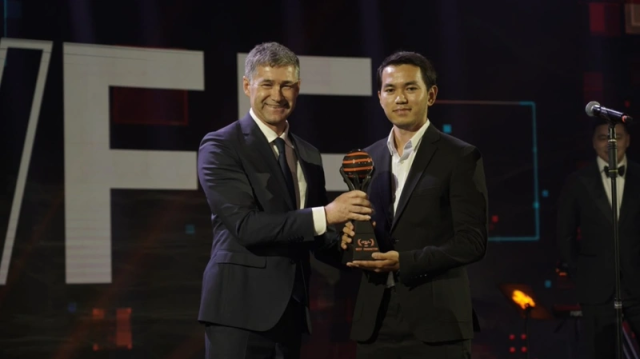
The $450,000 Grand Prix went to Latvian filmmaker Nikolay Shestak for The First Honest Day, entered in the main competition under the theme "The Future Worth Living In."
The three-day festival, held Oct. 1 to 3, was part of AI & Digital Bridge 2026, a technology forum at the center of a month of AI events Kazakhstan staged during what it declared its Year of Digitalization and Artificial Intelligence. Finalists' films were screened free to the public at a cinema in the capital.

President Kassym-Jomart Tokayev opened the festival on Oct. 2, calling it "a unique, unparalleled project" in which educated, innovative and creative people show their talents, according to a readout from Akorda, the presidential office.
President Tokayev said AI gives young people and small creative teams a way to compete with large studios and makes it easier to break into the film industry. He added that hosting the event in Astana was no accident, pointing out that the average age of Kazakhstan's population is 33.

India's SITARA took second place and $200,000. Spain's Looking For Perseida finished third, winning $100,000.
Five more films won $50,000 each in category awards for character, directing, visual language, story and concept.
Kazakhstan's Myrzakhan Zhumakhan took Best Character for It Was Just a Joke, a comedy in which a dog and its owner's brother fall out over a prank that plays out on the scale of a blockbuster. Zhumakhan said his own love of pranks and humor inspired the story.
An international jury chose the winners. Its members included Audrey Azoulay, who led UNESCO, the United Nations' cultural and scientific agency, from 2017 to 2025, and Balaji Srinivasan, a technology investor and former chief technology officer of the cryptocurrency exchange Coinbase.
The festival carried a total fund of $2 million, half of it for prizes. The other $1 million was set aside to back promising AI teams and film production in Kazakhstan, with selected teams eligible to join Astana Hub, the state-backed technology park for startups in the capital.
Park Sae-jin
Experienced journalist and editor at AJU PRESS specializing in multilingual news. I cover international diplomacy, geolpolitics, and policy, consistently delivering highly accurate, compelling reporting for a worldwide audience.
Copyright ⓒ Aju Press All rights reserved.
Related News
-
 Masayoshi Son's AI Bet Faces Challenges Amid Delays
Masayoshi Son, chairman of SoftBank Group, has invested 10 trillion yen (approximately 85 trillion won) in OpenAI. If OpenAI goes public, there will be an opportunity to recover part of the investment by selling shares. However, the IPO has been postponed. The U.S. data center that OpenAI plans to use must finish construction and connect to electricity before it can start generating rental income. While revenue is awaited, the dates for interest payments are marked on the calendar.The recent U.S. midterm elections have extended this wait. Last January, Son announced the 'Stargate' plan alongside President Donald Trump at the White House, which involved investing 75 trillion yen (approximately 637 trillion won) to build data centers for artificial intelligence (AI) across the United States. However, Trump’s Republican Party lost control of both the House and Senate. In Texas and Ohio, where the data center construction plans are concentrated, Democratic candidates critical of the construction were elected. The Texas representative pledged to halt new data center permits until regulations for resident protection are established.Delays in construction impact financial obligationsTo operate the data center computers around the clock, significant electricity is required, and water is needed for cooling. Residents are concerned about potential increases in their electricity bills and possible water shortages in their neighborhoods. With the state government indicating stricter regulations on electricity and water usage, projects awaiting permits may face delays. Even if construction is delayed, payments for previously ordered equipment must be made according to contracts.However, SoftBank's order for power generation equipment became controversial shortly after the elections. On November 6, Elon Musk, CEO of Tesla, claimed on X that SoftBank had failed to fulfill its contractual obligations after ordering power turbines. He did not provide evidence for his claim. Four days later, Yoshimitsu Goto, SoftBank Group's CFO, rebutted, stating, "This is completely untrue."On that day, SoftBank reported a net loss of 768 billion yen (approximately 6.5 trillion won) for the second and third quarters (April to September). The decline in profits was due to a decrease in the value of invested companies and a loss of about 600 billion yen resulting from changes in the procurement plan for power generation equipment for the U.S. data center. There were portions of the money already paid that could not be recovered, and changing contracts incurred additional costs. The company clarified the next day that this loss was unrelated to the large data center project 'PORTS-Pike' in Ohio. Securing power generation equipment in advance could expedite construction, but if plans change, significant losses could occur before the equipment is even utilized.SoftBank prioritizes Ohio's PORTS-Pike projectAs construction delays increase, the timing of debt repayments becomes more critical. Before the U.S. midterm elections, SoftBank repaid short-term debt used for additional investment in OpenAI. The company issued bonds overseas and borrowed money from banks for longer terms, using shares of the British semiconductor design company Arm as collateral. This allowed them to avoid a significant repayment deadline in the spring of next year. However, some of the new bonds have interest rates close to 10%. With the time gained, they now face the risk of needing to complete a revenue-generating project within that timeframe.SoftBank is currently in a position where it cannot allocate funds to multiple data center construction sites simultaneously. Therefore, it plans to focus on the 'PORTS-Pike' project in Ohio first. This site is the only data center with confirmed users upon completion. SoftBank subsidiary SB Energy has signed a 20-year lease agreement with OpenAI. NVIDIA has also agreed to back part of the initial project and invest in SB Energy. The presence of long-term customers and a company willing to share the risks of the initial project is a significant advantage when securing construction funds.However, even with a contract with OpenAI, the data center cannot be handed over until electricity is supplied. SB Energy has decided to bear the costs of constructing a new transmission network to supply electricity to PORTS-Pike, aiming to avoid passing those costs onto residents' electricity bills. The design also incorporates water recycling for cooling the computers. The local power company estimates that electricity supply through the new transmission network will begin in 2029.While waiting for electricity supply, SoftBank is exploring options to proceed with construction in phases in Ohio. They plan to start building in sections where permits have been obtained and electricity connection schedules are set, ordering equipment for the next sections based on construction progress. In Texas or other regions, if the timing of permits is uncertain or long-term customers are not secured, they may have to delay large orders that incur significant costs. If funds are allocated to multiple sites and construction delays occur, money needed to complete projects could become tied up.Securing new clients for data centers is crucialOnce the construction order is established, it is also essential to consider who will use the next data centers. SoftBank is both a major shareholder of OpenAI and the company leasing data centers to OpenAI. If OpenAI succeeds, the value of SoftBank's shares will rise, and they will also receive rental income. However, if OpenAI's situation worsens, both revenue sources will be jeopardized. If data centers built after PORTS-Pike are also leased to OpenAI, there will be an increase in facilities, but only one source of rental income. Analysts agree that "in the next project, it is crucial to find long-term customers outside of OpenAI and secure companies willing to share construction costs."Twenty years ago, when Masayoshi Son started his telecommunications business in Japan, there was a foundation to increase customers at the same pace as spending. He acquired the Japanese branch of British telecommunications company Vodafone, expanded the base stations, and attracted subscribers with affordable plans and the iPhone to generate profits.Unlike the success in Japan's domestic telecommunications market, in Ohio, even with long-term customers secured, there will be a long wait to complete data center construction and connect electricity. If new projects are pursued with borrowed money before receiving the first rental income, the hard-earned money from Ohio could be drained away by construction costs and interest from other sites. Masayoshi Son has historically seized opportunities by investing large sums ahead of others. To navigate this crisis, he must prioritize projects that can be completed and refrain from spending on less prepared sites. The market is watching to see if Son can overcome this AI investment crisis with the management style he has demonstrated in times of difficulty.* This article has been translated by AI.
-
President Lee Jae-myung: AI Data Centers are Key Infrastructure for Future Industries
President Lee Jae-myung emphasized the importance of artificial intelligence (AI) data centers as crucial infrastructure supporting future industries such as robotics and autonomous vehicles. He made these remarks during a visit to the construction site of the SK AI Data Center (AIDC) in the Mipo National Industrial Complex in Ulsan on the morning of November 21."In the past, highways opened the path to industrialization in South Korea, and now I believe many AI highways will be designed for the future of AI in South Korea," he stated.This visit was organized to assess the actual progress of the project following his attendance at the launch ceremony of the Ulsan AI Data Center last June, marking his first regional schedule since taking office. It follows his participation in the groundbreaking ceremony and the fourth inspection meeting for the Chungcheong mega project on November 12, expanding his site inspections to the Yeongnam region.The Ulsan SK AI Data Center is set to be the first among the government-promoted mega project AI data centers to begin operations by the end of 2027. It is expected to serve as the starting point for SK Group's construction of a 5-gigawatt (GW) AI data center.President Lee expressed gratitude to SK officials for their bold investments and swift progress, stating, "Last week I visited the Chungcheong region, and today I am visiting the Yeongnam region's mega project site."He added, "I expect the successful advancement of the Ulsan AI data center project will serve as a catalyst for attracting additional investments from global AI companies."He particularly stressed that expanding investments in advanced industries centered in local areas should be a catalyst for regional balanced development."What is important is that investments in AI infrastructure are being conducted with a focus on local areas," he noted, adding that this could serve as a real example of creating new growth momentum.He stated, "The main national task for South Korea is balanced development. Due to the concentration in the metropolitan area, various problems arise, and we need to create new opportunities in local areas, with mega projects serving as a crucial mechanism."President Lee also pointed out the issue of a shortage of skilled workers needed for constructing advanced industrial facilities."Overall, reports indicate that there is a significant shortage of personnel for advanced facility construction," he said, noting that there is a considerable lack of workforce for semiconductor facilities currently being developed, which could pose challenges for construction.He emphasized, "In a world where competition is fierce, speed is essential. The key to national competitiveness is speed. We will consider how to prepare the workforce more effectively."He also praised the role of local governments, stating, "Local governments play a significant role in permits and approvals, which has greatly helped increase speed."In response, Ulsan Mayor Kim Sang-wook said, "We will work hard, and it seems there will be much to do in the future."According to a written briefing by Deputy Spokesperson Ahn Gwi-ryeong, President Lee arrived at the SK AI Data Center construction site around 11 a.m., wearing a white safety helmet to inspect the progress of the construction. He received explanations from Kim Jong-yeon, the site manager of SK Eco Plant, regarding the construction progress, floor composition, and data hall facilities.The site manager reported that the current construction progress is at 71% and that the work is proceeding smoothly. President Lee inquired about the differences in construction costs and timelines compared to the metropolitan area while confirming the pace of the project.He also checked how power needed for the data center would be supplied and whether sufficient skilled workers for plumbing and equipment were available. After hearing that there was a shortage of construction personnel on-site, he expressed concern about the workforce supply issue.President Lee showed particular interest in ensuring a stable power supply system, noting that the AI data center must operate 24 hours without interruption.He specifically asked whether there would be any gaps in power supply during a power outage until emergency generators are activated. The site manager explained that power could be supplied through an uninterruptible power supply (UPS) for about three seconds during the switch to emergency generators.To ensure the stable operation of the AI data center, it is essential not only to secure sufficient power but also to have facilities in place that prevent power supply interruptions during emergencies such as outages.After completing the site inspection, President Lee moved to the nearby SK Chemical Ulsan plant to receive a report on the progress of the AI data center project and cooperative measures to revitalize the Ulsan regional economy.In a subsequent closed-door report, discussions were held with SK officials regarding the future outlook for the AI data center industry, South Korea's competitiveness in data center locations, and the proportion of power supply in overall project costs. Recent market turmoil related to AI and future demand forecasts were key topics of discussion.An SK official stated that the recent market turmoil is expected to stabilize, and demand for AI data centers is projected to increase explosively as we move toward a physical AI era that operates in the real world, including robotics and autonomous vehicles.President Lee expressed agreement with the notion that as technology advances, the demand for AI data centers and memory is likely to increase.He shared the outlook that the growing demand for data processing due to the advancement of AI technology could lead to continuous growth in the data center and semiconductor industries.The closed-door report also focused on the issue of power supply, which is crucial for the competitiveness of AI data centers.President Lee emphasized that utilizing eco-friendly renewable energy for stable and affordable power supply will be a key factor determining overall industrial competitiveness in the long term.He also showed interest in the job creation effects resulting from the construction and operation of AI data centers, particularly noting the need to address the shortage of skilled workers required for constructing advanced facilities to ensure it does not become a hindrance in the project advancement.The Ulsan AI data center project is significant as it represents large-scale advanced industrial investments being pursued outside the metropolitan area. President Lee stressed that it should serve as an opportunity to attract additional investments from related companies while securing new growth engines for the region.Attending the site visit were SK Group officials, including CEO Jeong Jae-hun of SK Telecom and CEO Jeong Seok-geun of SK Hynix, as well as Deputy Prime Minister and Minister of Science and ICT Baek Kyung-hun, Ulsan Mayor Kim Sang-wook, Ulsan Nam-gu Chief Im Hyun-cheol, Presidential Chief of Staff Im Kwang-hyun, and Chief of AI Future Planning Lee Hae-min.* This article has been translated by AI.
-
Gyeongnam Information University Expands Industry Collaboration and AI Capabilities
Gyeongnam Information University is expanding its workplace-oriented talent development programs, linking education and employment through field training in collaboration with industries, entrepreneurship programs utilizing local ingredients, and support for international students' job placements.Internally, the university is conducting practical training in generative AI for staff and accelerating the digital transformation across education and administration.On November 20, the university announced that its Department of Hair Design recently held the '2026 Hair Design Co-op Conference' in the Twin Tower Hall, providing a platform for students to interact directly with representatives from major domestic hair brands.The event, part of the Specialized College Innovation Support Project, was attended by over 80 students from the Hair Design department, faculty members, and representatives from Junohair, Pellia Hair, ID Hair, and Park Seung-cheol Hair Studio.Students heard from brand representatives about recent changes in the beauty industry, the qualities sought by companies, and the practical skills required in the field, helping them clarify their career paths and job directions.The university and participating companies agreed to continue linking education and employment to cultivate talent that meets industry demands.The Hair Design department operates customized training and field practice based on partnerships with large hair brands, incorporating the companies' technologies and service methods into the curriculum. This approach allows students to gain industry experience during their studies, leading to employment opportunities.A student from the Hair Design department who participated in the event said, "I was able to concretely understand the employment and fieldwork I had previously thought about vaguely by communicating directly with company representatives. Knowing what skills are needed in the actual field has clarified the direction I need to prepare for, and I have gained confidence."Professor Yoo Eun-joo from the Hair Design department stated, "This was an opportunity for students to communicate directly with major domestic hair brands, broadening their understanding of the industry and allowing them to concretely plan their career paths. We will cultivate beauty talent equipped with the expertise and practical skills demanded by the industry through close cooperation with companies."Supporting International Students' Employment and Strengthening Local PartnershipsGyeongnam Information University is strengthening industry-academic cooperation with manufacturing companies in Busan to support the local employment and settlement of international students.On November 18, the university signed a 'Memorandum of Understanding for Employment of International Students in Local Settlements' with Hanraibitech Co., a manufacturing company located in Gangseo-gu, Busan, at the Minseok Memorial Hall on campus.The two institutions will jointly promote the development of customized educational programs for international students, field training, company tours, and industry-academic linked education. They plan to establish a system that allows international students to secure employment with local companies and settle in Busan after receiving education at the university through pre-employment training and shared use of equipment.There have already been cases of successful employment. A Vietnamese student, Tran Duc Luong, currently in the second year of the Mechanical Engineering program at Gyeongnam Information University, passed an interview with Hanraibitech Co. in October. He is currently applying for a change of status to a professional employment visa (E-7) and plans to join the company once the visa is issued.President Kim Tae-sang stated, "We will expand cooperation with local companies so that international students can learn and work in Busan and establish themselves as members of the community."Culinary and Entrepreneurship Experience with Local IngredientsStudents from the Department of Hotel Culinary Arts and the Department of Hotel Baking and Pastry showcased their culinary skills and entrepreneurship ideas using local ingredients.Recently, Gyeongnam Information University held the '2026 KOREA World Food Championship' for college students and the 'KIT Anchor K-Food Entrepreneurship Competition' at the 50th Anniversary Memorial Hall on campus.Over 60 participants competed in the college student category of the World Food Championship. The Department of Hotel Culinary Arts won 20 gold medals, 10 silver medals, and 3 bronze medals. Third-year student Kim Eun-hye and first-year students Kim Seung-jun and Kim Sang-jin received the grand prize from the Minister of Oceans and Fisheries for their menu utilizing Busan seafood, while students Jang Seung-wook, Kwon Gi-hyun, and Park Min received the Excellence Award from the President of the Korea Agro-Fisheries & Food Trade Corporation.In the Department of Hotel Baking and Pastry, 24 students were awarded, including 12 gold medals, 8 silver medals, and 4 bronze medals. Students Jo Hye-young and Park Ye-seo in the marzipan craft category received the Minister of Oceans and Fisheries Award, and winners were also announced in the dessert and sugar craft categories.The 'KIT Anchor K-Food Entrepreneurship Competition,' held as part of the Busan Regional Growth Talent Development Project, featured 13 teams from the two departments. Students developed menus utilizing Busan's local specialties and were evaluated on product viability, marketability, and entrepreneurial potential.Items using local ingredients, such as shrimp fish cake tarts, chive rolls, Cheolma Hanwoo Wellington, and tacos and quesadillas, received the top awards, with the two grand prize teams and two excellence award teams each receiving 300,000 won (KRW) and 200,000 won (KRW), respectively.Vice President Lim Jun-woo stated, "The process of students planning menus and commercializing them using Busan seafood and local ingredients has led to good results. We will strengthen practical training in developing restaurant and bakery menus based on local food."Staff Training in Generative AI and Digital TransformationAlongside students' field training, the university's internal work processes are also changing with a focus on AI.The university's Teaching and Learning Support Center conducted the '2026 KIT Staff AI Practical Skills Enhancement Workshop' over two sessions, totaling 18 hours across six days on October 27-29 and November 10-12.This training, organized as part of the AID (AI-Digital) Transition Support Project for Specialized Colleges, focused on directly applying generative AI to administrative tasks to enhance work efficiency.The university divided the training into basic (Start), intermediate (Work), and advanced (Innovate) courses based on the results of an AI competency assessment conducted for all staff. The basic course covered document and report writing and data research using ChatGPT, while the intermediate course included file and Excel data processing and analysis of repetitive tasks.The advanced course involved designing and implementing programs to automate repetitive tasks using the AI coding tool Codex.Gyeongnam Information University is promoting measures to transform both education and administration by integrating AI into administrative training for staff, incorporating AI into faculty teaching methods, and introducing AI training into student courses.Vice President Joo Won-sik stated, "We structured the training to help staff go beyond merely using AI to actually applying it for work efficiency and automation. We will continuously support the AI competency of our members to ensure that administration, teaching methods, and student education can evolve together."* This article has been translated by AI.