

BGF Retail, the operator of CU, said in a statement on August 1 that the company started a drone delivery service in the Tancheon water parks. Anyone can receive products such as snacks and quasi-drugs using a QR code. The service is part of Seongnam City's project to commercialize drone delivery service.
Starting in September, the convenience store operator will also adopt the drone delivery service at a campsite in Taean County some 110 kilometers (68 miles) southwest of Seoul. Taean was selected as South Korea's regulation-free zone for drones in 2021. Drone developers can freely use the tourist town as a testbed for newly developed drones.
Although drones equipped with optical equipment were mostly used to carry out dangerous missions in the early days of commercial introduction, their role has been expanded to many other fields. In December 2021, smart farm drones that can analyze crops' temperature and humidity were showcased in Chuncheon some 75 kilometers (46.6 miles) northeast of Seoul.
Copyright ⓒ Aju Press All rights reserved.
Related News
-
 Han River Drone Show Attracts 240,000 Visitors, Boosts Local Economy
The drone performances set against the night sky of the Han River are becoming a key nighttime tourism attraction in Seoul, drawing visitors and boosting local spending. This year, over 240,000 spectators attended eight performances, with card sales in nearby areas increasing by 21.6% compared to normal times. The shows, which blend advanced technology with storytelling, have been credited with enhancing the local economy beyond just the visual spectacle of the Han River. The Seoul Metropolitan Government announced on November 17 that a total of 240,782 visitors attended the '2026 Han River Drone Light Show' held at Yeouido, Ttukseom, and Jamsil Han River Parks from April to October this year. The average attendance per show was 30,098, a 7.2% increase from last year's average of 28,074. Compared to the inaugural year in 2023, which saw 11,305 attendees, this year's figures represent an increase of approximately 2.7 times. This year's performances expanded their themes to include globally recognized characters as well as elements of Korean history and sports. Themes such as BT21, Line Friends, Star Wars, Marvel, 'Garden of Life,' 'Mystical Sea,' 'K-Baseball, Seoul Night,' and 'Joseon Fantasy' were showcased, allowing audiences to experience new stories with each performance at the same location. On Children's Day, May 5, a special Star Wars performance at Jamsil Han River Park featured 2,000 drones, while a Marvel special on October 31 at Ttukseom Han River Park also utilized 2,000 drones. These performances brought popular culture to life through three-dimensional light representations of characters and iconic scenes, enhancing the Han River's night view. The interest from foreign tourists was also notable. This year, 62,555 foreign visitors attended, making up 26% of the total audience. This means that one in four attendees was a foreigner. Notably, the 'BT21 in Seoul' event on April 10 at Yeouido Han River Park attracted 26,771 attendees, of which 13,290 were foreign visitors, accounting for nearly 49.6% of the audience. These attendance figures were calculated based on Seoul's resident population data during the performance hours from 8 to 9 p.m. While the ticket sales figures differ from this count, they provide an indicator of the demand for the open Han River parks and the proportion of foreign visitors. The influx of tourists coincided with increased sales in nearby areas. During the eight days of performances, card spending in the vicinity totaled 3.06026 billion won, a 21.6% increase from the usual 2.51596 billion won. Foreign card spending rose from 453.67 million won to 789.83 million won, marking a 74.1% increase. The usual figures were based on the average for the same day of the week over the four weeks leading up to each performance. The changes were even more pronounced in Ttukseom, where six of the eight performances took place. Card sales in nearby areas increased by 43.3% compared to normal times, and the number of transactions rose by about 44%. Foreign card sales surged by 448.7%, with transaction numbers increasing by 455.2%. Even considering that foreign sales are relatively small during normal times, the increase in spending on performance days was significant. The average card sales in the Ttukseom area rose from about 131.23 million won during normal times to approximately 188.02 million won on performance days. Foreign sales increased from about 3.68 million won to 20.17 million won. Visitors to Ttukseom Han River Park also increased by 151.2% compared to normal times, with foreign visitors rising by 323.3%, indicating a trend of increased attendance and spending on performance days. Programs linking performances with local food offerings have also seen success. The K-Food experience program, in collaboration with Baedal Minjok and Jayang Traditional Market, enhanced the food experience for attendees. The direct transaction market, 'Farmers' Market,' recorded sales of 144 million won over the three days of the drone show, with average daily sales 47.7% higher than on non-show days. This highlights that the success of nighttime tourism can be measured not only by attendance figures but also by the spending generated in the surrounding areas. By connecting visitors waiting for or finishing performances with dining, shopping, and experiential activities, there is greater potential to extend the tourism demand gathered at the Han River into nearby commercial areas. The Seoul Metropolitan Government is nurturing the Han River Drone Light Show as a nighttime tourism content that supports the 'Seoul Tourism 3-3-7-7' goals. This policy aims for 30 million foreign tourists, an average spending of 3 million won per person, a stay of seven days, and a 70% revisit rate. The plan is to connect the experience of enjoying the Han River's night view with longer stays and spending in Seoul. Cho Sung-ho, head of the Seoul Tourism and Sports Bureau, stated, "The Han River Drone Light Show has grown into a nighttime tourism content loved by domestic and international tourists, blending Seoul's night view with world-class content. We will continue to present diverse attractions and experiences to ensure global interest translates into visits and spending in Seoul."* This article has been translated by AI.
-
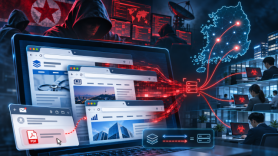 North Korea-linked hackers resume cyber operations to steal drone technology
An artificial intelligence (AI)-generated image SEOUL, November 12 (AJP) - A North Korea-linked hacking group has apparently resumed cyberespionage operations targeting Europe's drone industry, Voice of America reported on Thursday. Citing a report by Slovakia-based cybersecurity firm ESET, the U.S. state-funded broadcaster said the Lazarus Group resumed its hacking activities around June. The group used fake job offers to trick employees at defense companies into installing malicious software, in an attempt to obtain sensitive information about drone technology and manufacturing processes. ESET said the cyber activities may be part of North Korea's broader push to strengthen its domestic drone industry, as Pyongyang appears to recognize the growing importance of drones on the battlefield amid its military support for Russia's war against Ukraine. In one case detailed in the report, an employee at a European defense company received a password-protected file containing what appeared to be a job offer from British aerospace company BAE Systems. The PDF was designed so it could not be opened normally, prompting the employee to run a separate program included in the file to view the document. That program displayed the fake job offer while secretly installing malware on the employee's computer. The tactic resembles Lazarus' long-running "Operation DreamJob" campaign, in which hackers pose as recruiters from well-known companies to trick employees into opening malicious files and gain access to their systems. ESET said the hackers targeted not only manufacturers of complete drones but also suppliers of critical components, suggesting they sought to gather information about both the technology used in drones and the processes involved in making them. However, the report did not disclose whether the hackers successfully obtained sensitive technical information, nor did it specify what data, if any, may have been stolen. ESET also identified South Korea as an increasingly prominent target of North Korea-linked hacking groups, amid Pyongyang's growing military ties with Moscow.
-
Six Defense Innovation Products Designated, Including Drone Stations and Combat Uniforms
The Ministry of National Defense and the Ministry of Economy and Finance have designated six products as the first defense innovation items, including mobile drone stations and flame-resistant combat uniforms. This initiative aims to support the rapid adoption of civilian technologies that meet military needs and assist innovative companies in entering the public procurement market. On November 12, the two ministries announced the designation of these six defense innovation products through the Public Demand Discovery Committee, led by the Ministry of Economy and Finance. The defense innovation product designation system was established in December last year to quickly introduce and expand the use of civilian innovative technologies and products needed by the military. Previously, the military purchased and utilized innovation products designated by other ministries, but this time, it has independently identified and designated products that reflect the unique demands and requirements of the defense sector. The designated products have been recognized for their excellence through four programs: defense research and development, military-civilian technology cooperation projects, the excellent commercial product pilot program, and the introduction of new technologies in defense informatization. Out of 171 applications, the Ministry of National Defense reviewed potential military demand and selected 16 projects for further consideration. After evaluating nine applications based on public interest, innovation, and procurement suitability, six products were ultimately designated. The designated products include equipment for washing, disinfecting, and drying gas masks, mobile drone stations, and 'No Melt No Drip' combat uniforms. These items can be utilized in various areas, including military equipment management, operational execution, and soldier safety and clothing. Once designated as innovation products, these items can be procured through direct contracts for a minimum of three years. This allows the military to quickly introduce products that meet its needs while providing companies with opportunities to secure initial market access through public procurement. The two ministries plan to expand the scope of designated products and improve evaluation criteria and operational procedures starting next year. They aim to increase the discovery of civilian technologies and products that align with military demands by incorporating feedback from this year's initial implementation. The Director of the Logistics Management Bureau at the Ministry of National Defense stated that this designation establishes a foundation for utilizing excellent civilian innovative technologies and products to meet various military needs. He expressed hope that the introduction of civilian technologies into the military would create a virtuous cycle leading to enhanced advanced defense capabilities and continuous technological development by innovative companies. The Procurement Contract Policy Officer at the Ministry of Economy and Finance noted, “We will work closely with the Ministry of National Defense to activate innovative procurement in the defense sector while also collaborating with new institutions such as the Aerospace Administration and local governments to broaden the path for innovative products to actively enter the public market.”* This article has been translated by AI.